Monday, June 5, 2017

One Day in the Eucalyptus, Eucalyptus Tree


One Day in the Eucalyptus, Eucalyptus Tree by Daniel Bernstrom, pictures by Brendan Wenzel (2016) #ownvoices 

This is one of those books that just delights in words, sounds, and vocabulary. A boy strolls along, distracted by his pinwheel and is gobbled by a snake under the eponymous branches of the eucalyptus tree. The boy keeps convincing the snake that there’s room for the snake to keep eating—his belly isn’t full yet. Of course, eventually the snake reaches his limit, and, with an enormous belch, all the eaten creatures are freed. The snake slithers off with a tummy-ache, and the boy reclines happily in the shade of the tree—but a crocodile peeks around, hinting at more adventures. I love this one, and I think it’s a delight to read out loud, but do recommend practicing it because there are a couple of places where the rhymes take an unexpected rhythm.

Themes/topics: Jungle, snakes, trees, tricksters, flies, eating

Sample text from three spreads:
One day in the leaves of the eucalyptus tree hung a scare in the air where no eye could see, when along skipped a boy with a whirly-twirly toy, to the shade of the eucalyptus, eucalyptus tree.

Down, down slid the snake from the leaves of the tree and gobbled up the boy with his whirly-twirly toy, one day in the eucalyptus eucalyptus tree.

“I’ll bet,” said the boy, in the belly dark and deep, “that you’re still very hungry and there’s more that you can eat.”
“Do you think,” said the snake to the boy with the toy, “That there’s room for something yummy with you inside my tummy?”

Wednesday, May 31, 2017

More-igami by Dori Kleber and G. Brian Karas


More-igami by Dori Kleber, illustrated by G. Brian Karas (2016)
Joey loves loves loves things that fold—tacos, maps, the accordion, and his foldaway bed. One day his classmate’s mother demonstrates origami to his class at school, and Joey is enraptured. He begins folding everything he can get his hands on, from his homework to his mother’s recipe cards until, “This folding has to stop.” Demands his mother. Dejected, Joey wonders how he’ll be able to become a master folder if he can’t practice. Adorably, at the Mexican restaurant next door he finds both encouragement and the answer to his problem—folding napkins to decorate the tables.

Themes/topics: persistence, origami, art, practice, problem solving, restaurants

Sample text from three spreads:
One day, Sarah Takimoto’s mother came to school. She took a plain piece of paper. She folded it, and flipped it, and pulled it, until it became…

A crane.

Joey’s eyes popped. His jaw dropped. Mrs. Takimoto called it origami. “I want to make origami,” Joey told her. “Will you teach me?”
“I can show you the folds,” she said, “but if you want to be an origami master you’ll need practice and patience.”


Tuesday, May 30, 2017

How to Find a Fox by Nilah Magruder


How to Find a Fox by Nilah Magruder (2016) #ownvoices

A plucky little adventurer sets out with backpack and camera in hand—determined to find a fox. The narrator explains the best way to go about finding a fox, while the illustrations show the girl stymied at every step and the sly fox always just out of her sight.  As soon as she gives up or turns away, there’s the fox doing just what she wanted it to. Highlights include the fox disguised as an owl and a raccoon. Frustrated, she wants to give up, but the narrator instructs her to take a deep breath and a mental break before going on. And, of course, the fox shows up in the end and the final spread is a bunch of snapshots of their time together. I love that the girl gets to explore nature on her own terms, and the way that the text provides a script for what to do when you’re frustrated and want to give up. Kids will love looking for the fox’s tricky antics.

Themes/topics: Adventure, persistence, nature, animals, searching, tricksters

Sample text from two spreads:

Tread slowly over the ground. Foxes have keen hearing. You don’t want to startle them. Be sure to look for fox tracks. They’re like dog tracks, but sneakier.

Take a picture of a family of raccoons. They have bushy tails kind of like foxes. Put out more bait. Wait longer this time. 


Monday, March 27, 2017

Mina’s White Canvas


Mina’s White Canvas by Heyeon-Ju Lee (2015) #ownvoices  


Mina feels gray and gloomy—just like the weather. Like her many literary predecessors, she begins to draw snowflakes, which quickly transform her world into a vast landscape to explore. She meets various animals, and solves their problems with her magic crayon, adding more and more color to her world. Mina sits comfortably next to Harold and his purple crayon, with a shorter story more suited to storytime that also has a focus on helping others.

Themes/topics: Helping, kindness, drawing, crayons, imagination, adventure

Sample text from two spreads:

The new friends walked through the forest. “Look!” Said Mina. “I see someone in that cave!”

It was Mr. Bear. He had grown so fat during the long winter that he was stuck in the cave opening. Mina and Grandfather Woodpecker pulled and tugged, but they could not get him out.

Mina took her crayon and drew a big blue door on the side of the cave. Hooray! It was just the right size for Mr. Bear!


Saturday, March 25, 2017

A Hat for Mrs. Goldman


A Hat for Mrs. Goldman by Michelle Edwards and G. Brian Karas (2016)

Sophia’s neighbor, Mrs. Goldman, knits hats for everyone in her life, and Sophia makes pom poms to adorn them. One winter, Sophia notices that Mrs. Goldman’s generosity has left her with no hat of her own, so Sophia decides to make one for her. Unfortunately, Sophia’s skill doesn’t quite match up with her intention, and she’s frustrated by her lumpy hat. It is, of course, perfect in Mrs. Goldman’s eyes. This book made me teary in the same way as Sophie’s Squash—perfectly sweet and funny without being saccharine. Mrs. Goldman is Jewish, and Sophia references grandparents in Argentina—refreshingly reflective of the many ways that lives and people intersect. A bit longer than most storytime books, this is one I’d make an effort to include. Heart—and head—warming.

Themes/topics: kindness, neighbors, creativity, crafts, knitting, good deeds

Sample text from first two spreads:

When Sophia was a tiny baby, Mrs. Goldman next door knit her a tiny baby hat to keep her warm.

Now Sophia is big, and she makes the pom-poms for Mrs. Goldman’s hats. Hats for the tiniest babies. Hats for small, medium, and large friends and neighbors. Mrs. Goldman taught her how. “Keeping keppies warm is our mitzvah,” says Mrs. Goldman, kissing the top of Sophia’s head. “This is your keppie, and a mitzvah is a good deed.”


Thursday, March 9, 2017

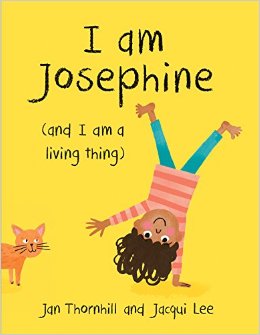
I am Josephine (and I am a living thing) by Jan Thornhill and Jacqui Lee


I am Josephine (and I am a living thing) by Jan Thornhill and Jacqui Lee (2016)

This book made me so happy when it came across my desk—I don’t order nonfiction, so it was a surprise.  Josephine tells us that she is a human being, talks about other human beings, and invites readers to point out other human beings on a full spread. She then defines herself as a mammal, an animal, and a living thing following the same pattern. This book is a great introduction to the concept of how humans fit into broader categories, while still being unique individually. The delightful pictures, by the illustrator of the fabulous reader series, Murilla Gorilla, are large, clear, and perfect for sharing during storytime.

Themes/topics: people, self-esteem, individuality, STEM, categories

Sample text from two spreads:
I am Josephine, and I am a living thing.
I am a living thing, and so is my brother, Felix, and so is a butterfly, and so is a tree, and so is a penguin. How many different living things can you find on this page?